
Heme Iron: Why Absorption Matters More Than the Number on the Label
More than four billion people don't consume enough iron, not because iron-rich foods are rare, but because most of the iron people eat is in a form the body can barely use. The number on a nutrition label tells you almost nothing about how much iron actually makes it into your bloodstream. This is the part the supplement industry rarely explains, because the answer doesn't sell fortified cereals.
What is heme iron?
Heme iron is the form of iron found exclusively in animal foods: meat, organs, poultry, and seafood. It's iron that's bound to a haem protein (the same protein structure that carries oxygen in red blood cells), which allows it to be absorbed through a dedicated transport pathway in the gut wall. Non-heme iron, found in plant foods and most iron supplements, travels a different and far less efficient route. The distinction matters enormously when it comes to how much iron your body actually receives from any given meal or capsule.
The reason heme iron absorbs so differently comes down to structure. Because heme iron enters the intestinal cell as an intact metalloporphyrin complex (essentially the whole protein-iron unit), it bypasses the processing steps that slow non-heme iron down. It doesn't need to be chemically reduced before absorption. It has its own dedicated receptor. It moves through the gut wall and into the bloodstream via a pathway that evolved specifically to handle it.
The nutritional case for heme iron
Heme iron absorption runs at 15 to 35%, depending on your current iron stores. Non-heme iron, the form found in spinach, lentils, fortified cereals, and most iron supplements, absorbs at somewhere between 2% and 12%, and that upper figure requires ideal conditions that rarely exist in a real meal.
Here's what that means in practice. A 100g serving of beef liver contains roughly 6mg of total iron, a large proportion of which is in the heme form. Your body absorbs a reliable 25 to 30% of that. A bowl of cooked lentils might contain 3mg of iron per 100g, but absorption sits closer to 3 to 5% under typical dietary conditions. The lentils look competitive on paper. In your bloodstream, it's not close.
The most striking figure is this: heme iron represents only 10 to 15% of total dietary iron intake in Western populations, yet it accounts for approximately 40% of all iron actually absorbed. That ratio, contributing three to four times its proportional share of absorbed iron, is what makes heme iron categorically different, not just incrementally better.
According to the World Health Organization, iron deficiency is the most common nutritional deficiency globally, with roughly 25% of the world's population anaemic and around half of those cases attributed directly to insufficient iron. A 2024 modelling analysis published in The Lancet Global Health found that more than 4 billion people worldwide fail to consume adequate iron, a figure that reflects not just how little iron many diets contain, but how poorly absorbed the iron that is consumed tends to be.
There's a structural reason non-heme iron falls short. Non-heme iron absorption is aggressively disrupted by dietary compounds present in many common foods: phytates in grains and legumes, tannins in tea and coffee, calcium in dairy. If you eat a high-iron vegetarian meal alongside tea, a common combination in much of the world, your non-heme iron absorption can drop to near zero. Heme iron absorption is largely insulated from these inhibitors. It travels its own dedicated transport channel and is not meaningfully disrupted by the rest of what you ate. This means that a diet built around animal foods delivers iron reliably, not subject to the unpredictable arithmetic of what else was on your plate.
Why source quality changes everything
New Zealand's year-round pasture-raised beef system matters here for a specific reason. A 2025 study published in the Journal of Animal Science found that grass-fed, rotationally grazed cattle on plant-diverse pastures contained measurably higher mineral levels than grain-finished cattle, including 2.29mg of iron per 100g of muscle meat versus 1.92mg per 100g in grain-fed cattle. The nutritional difference was directly tied to pasture diversity: cattle grazing a wider variety of plants accumulated more minerals across the board.
That difference becomes more significant when you're looking at organ meats, which concentrate minerals at rates muscle meat doesn't approach. Our beef spleen contains approximately 31mg of total iron per 100g of raw tissue, with around 73% of that in the highly absorbable heme form. That translates to roughly 22mg of bioavailable heme iron per 100g, before accounting for the 25 to 30% absorption advantage on top. No plant food comes within reach of that number. Beef liver comes in at approximately 6mg of total iron per 100g. Beef kidney contributes around 4 to 5mg. Each organ brings a different iron density, which is why our organ complex draws from across the full range.
Grain-fed feedlot cattle are finished indoors on energy-dense rations designed to maximise growth rate and fat deposition, not nutritional density. The mineral profile of the animal reflects what it ate and how it moved. When cattle graze diverse pastures year-round, as New Zealand's farming system requires, the depth of that mineral profile is measurably better. This isn't a claim we invented. It's a straightforward consequence of animal physiology and what it grazes on.
New Zealand's regulatory baseline reinforces this at every level. Growth hormones are banned by law for beef cattle. Our animals graze outdoors 365 days a year; this is not a premium tier option, it's the standard that every New Zealand beef farmer operates under. The iron you get from our organs starts with better raw material before a single step of processing occurs.
Common questions about heme iron absorption
Can I get enough iron from plant foods alone?
Technically possible, but practically difficult. Plant-based diets require substantially higher total iron intake to achieve the same level of absorbed iron, because non-heme iron absorption is lower and far more variable. The NHS recommends that vegetarians and vegans aim for approximately 1.8 times the standard iron RDA specifically to account for this gap. If you're eating no animal foods and not tracking your iron intake carefully, deficiency is a realistic outcome over time, particularly for pre-menopausal women, athletes, and anyone with elevated iron demands.
Why do iron supplements often cause digestive side effects?
Most iron supplements use ferrous sulphate or ferrous gluconate: synthetic, non-heme iron forms taken in doses far exceeding what food naturally provides. High-dose non-heme iron in the gut causes oxidative stress to intestinal cells and disrupts the gut microbiome, which is why nausea, constipation, and cramping are so common with standard iron supplements. Heme iron from whole food sources, delivered in physiological doses, doesn't produce the same effect. Your digestive system has evolved to handle heme iron. It has not evolved to handle 65mg of ferrous sulphate on an empty stomach. This is one reason we've never included synthetic iron forms in any Field & Form product; the whole-food matrix does work the isolated compound can't replicate.
Does cooking affect heme iron content in organ meat?
Some, but not dramatically. Research has found that cooking beef reduces heme iron content by approximately 10 to 15% depending on method and temperature. Gentle cooking methods with lower heat and shorter times preserve more. In freeze-dried organ supplements, where raw tissue is processed at low temperatures rather than high-heat drying, the iron profile is well-preserved. This is one reason we cold-process our organs. Heat is efficient for manufacturing. It's not efficient for preserving the nutrient density you're paying for.
How much heme iron do I actually need per day?
The RDA for iron is 8mg per day for adult men and post-menopausal women, and 18mg per day for pre-menopausal women, rising to 27mg during pregnancy. Given heme iron's absorption rate of 25 to 30%, a diet delivering meaningful organ meat intake can hit these targets efficiently without the high-dose loading that synthetic supplements require. A single 100g serving of beef spleen, at a 25% absorption rate, delivers roughly 5 to 6mg of absorbed iron from one food source, with no inhibitor interactions to subtract.
Is it possible to get too much iron from eating organ meat?
Iron overload from whole food sources is rare in healthy adults. Your body regulates heme iron absorption with more flexibility than is often stated, reducing uptake as iron stores fill. The population at genuine risk is those with hereditary haemochromatosis, a genetic condition affecting roughly 1 in 200 people of Northern European descent, in which iron absorption regulation is impaired. For healthy adults without this condition, eating organ meat regularly is not a pathway to toxicity. If you have a known iron storage disorder, speak to a doctor before supplementing with anything, including whole-food organ supplements.
How we approach this at Field & Form
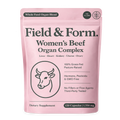
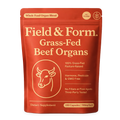
When we built our organ complex, including beef spleen wasn't a difficult call. Gram for gram, it delivers more bioavailable heme iron than almost any other food that exists. What surprised us was how few competitors used it. Most organ supplement formulas stop at liver, heart, and kidney, which are better known and easier to source, and leave spleen off the label entirely. We included it specifically because of the iron profile, and because we wanted our complex to cover the full range of nutrients that nose-to-tail eating historically provided.
We built Field & Form because we couldn't find a supplement that met what we considered a basic standard: whole-food iron in the form your body actually absorbs, from animals raised in a system that produces genuinely nutrient-dense meat. New Zealand's pasture-raised standard isn't a marketing position for us; it's the only sourcing we're willing to use, because the nutritional output of the animal is directly tied to the system it lived within. Our organs are freeze-dried at low temperatures to preserve the iron, enzyme, and cofactor profile. Nothing is added. No synthetic iron fortification, no fillers, no flow agents.
The label tells you what's in the capsule. The sourcing tells you what the animal ate. Both matter more than the number on the front of the box.
If you haven't read our piece on beef spleen specifically, it covers the iron profile in more detail. Our article on beef kidney sits at the other end of the mineral spectrum: selenium and B12 rather than iron, and worth reading alongside this one to understand how different organs complement each other in a complete formula.
Iron deficiency remains the most widespread nutritional deficiency on earth. The solution isn't always more iron. It's the right iron, absorbed reliably, from a source you can trace.
Last updated: 6 April 2026
Ready to feel the difference?
Five grass-fed organs. Freeze-dried. No fillers. 30-day supply.
Shop Beef Organ Complex