
Why Our Ancestors Ate Nose-to-Tail (and Why We Stopped)
For roughly three million years, humans ate the whole animal. Not just the muscle meat we fill supermarket shelves with today, but the liver, heart, kidneys, spleen, and brain. Archaeological evidence from sites in Dikika, Ethiopia shows early hominins used stone tools to access bone marrow and organ tissue long before they developed the ability to hunt large game. Organs weren’t a backup plan. They were the priority.
What Is Nose-to-Tail Eating?
Nose-to-tail eating is the practice of consuming the entire animal, including the organs, bones, connective tissue, and fat, rather than discarding everything except the muscle meat. It reflects how humans evolved to eat for millions of years and how many traditional cultures still approach animal foods today. The term was popularised by British chef Fergus Henderson in the 1990s, but the practice itself is older than agriculture, older than cooking, and likely older than spoken language.
The Nutritional Case for Eating the Whole Animal
Modern nutritional science is catching up to what our ancestors already knew instinctively: organ meats are among the most nutrient-dense foods on the planet.
According to USDA FoodData Central, 100g of beef liver contains approximately 16,898 IU of vitamin A (as retinol), 59.3mcg of vitamin B12, 6.5mg of iron, and 12.6mg of zinc. Compare that to 100g of beef sirloin, which delivers zero vitamin A, 1.15mcg of B12, 1.6mg of iron, and 3.8mg of zinc. The organ isn’t just slightly better. It’s operating in a different category entirely.
Beef heart is one of the richest natural sources of Coenzyme Q10 (CoQ10), a compound essential for mitochondrial energy production. A 2018 study published in the journal Food Chemistry measured CoQ10 levels in various bovine tissues and found heart muscle contained the highest concentration, roughly 113mg per kilogram of tissue. Your body produces less CoQ10 as you age, and heart tissue remains one of the few whole-food sources that delivers it in meaningful amounts.
Beef kidney provides a concentrated source of selenium, with the USDA reporting approximately 141mcg per 100g. That’s more than twice the daily recommended intake in a single serving. Selenium plays a direct role in thyroid function and antioxidant defence, and kidney also provides DAO (diamine oxidase), an enzyme involved in histamine metabolism that’s difficult to find in other foods.
The pattern holds across every organ. Spleen is loaded with heme iron and tuftsin, a peptide studied for its immune-modulating properties. Pancreas contains naturally occurring digestive enzymes, including trypsin and lipase. Each organ developed to perform a specific function in the animal’s body, and the nutrients concentrated in that tissue reflect that function. This is the principle behind “like supports like,” a concept that shows up in traditional medicine systems from Chinese to Ayurvedic to indigenous American.
What makes these nutrients particularly valuable is their bioavailability. The iron in organ meats is predominantly heme iron, which the body absorbs at roughly 15-35% efficiency compared to 2-20% for the non-heme iron found in plant foods and most synthetic supplements, according to research published in the American Journal of Clinical Nutrition. The vitamin A in liver is preformed retinol, ready for immediate use, unlike the beta-carotene in plant foods which requires conversion at a rate that varies wildly between individuals.
Why We Stopped Eating Organs
If organ meats are so nutritionally superior, why did most Western countries abandon them?
The shift happened gradually across the 19th and 20th centuries. Industrialisation moved populations from farms to cities. People lost their connection to whole-animal processing. Slaughterhouses centralised and streamlined, and the most profitable cuts, steaks, chops, and roasts, became the focus of marketing and retail.
By the mid-20th century, organ meats had been rebranded as “offal” and associated with poverty. Marketing pushed muscle meat as the aspirational protein. Liver and onions became a punchline rather than a staple. In the United States, per capita organ meat consumption dropped from around 2.5kg per year in the 1940s to less than 0.5kg by the 2000s, according to USDA disappearance data.
This wasn’t a nutritional decision. It was a cultural and commercial one. The most nutrient-dense parts of the animal were sidelined because they didn’t fit neatly into styrofoam trays or fast-food menus.
Meanwhile, the supplement industry stepped in to sell isolated synthetic vitamins to fill the gaps that whole-food nutrition used to cover. Retinyl palmitate instead of liver. Cyanocobalamin instead of kidney. Ubiquinone in a capsule instead of heart. We replaced an entire nutritional system with fragments of it.
Traditional Cultures Knew Better
Every traditional culture that relied on animal foods prized the organs above the muscle.
The Inuit of northern Canada and Greenland consumed raw liver and brain immediately after a hunt, reserving muscle meat for dogs or for drying. Weston A. Price, the dentist who studied indigenous diets across the globe in the 1930s, documented repeatedly that healthy traditional peoples went to great lengths to obtain organ meats, often trading or travelling significant distances for them.
The Maasai of East Africa consumed a mixture of blood and milk as a daily staple, and liver was reserved for pregnant women and growing children. Plains Indians of North America ate buffalo liver raw on the hunt, sometimes with the bile from the gallbladder squeezed over it to aid fat-soluble vitamin absorption. In traditional Chinese medicine, organ consumption follows the doctrine of “like nourishes like”: eating liver supports liver function, eating kidney supports kidney health.
These weren’t superstitions. They were survival strategies refined over generations. And when researchers examine the nutritional profiles of these foods with modern tools, the data supports exactly what these cultures practised.
Why Source Quality Changes Everything
Not all organ meats are created equal. Where and how the animal was raised affects the nutrient density and safety of its organs directly.
A 2010 study published in the British Journal of Nutrition found that grass-fed beef contained significantly higher levels of omega-3 fatty acids, conjugated linoleic acid (CLA), and antioxidant vitamins (including vitamin E and beta-carotene) compared to grain-fed equivalents. The differences were most pronounced in organ tissues, where nutrients accumulate at higher concentrations.
This is why we source exclusively from New Zealand. NZ cattle are pasture-raised year-round on open grassland, in a country that banned growth hormones in livestock production. There’s no feedlot finishing, no routine antibiotic use, and no GMO feed. The result is organ tissue that’s cleaner and more nutrient-dense than what you’d get from conventional supply chains.
Most organ supplement brands don’t specify where their organs come from. When they do, many source from South America, primarily Argentina or Brazil. While those countries do produce grass-fed beef, supply chain traceability is weaker, environmental oversight is less rigorous, and the connection between deforestation and cattle ranching in South America is well documented. We chose New Zealand because it gives us confidence in every step from pasture to capsule.
Common Questions About Nose-to-Tail Eating
Is it safe to eat organ meats regularly?
Yes. Organ meats have been a regular part of the human diet for millions of years. The main consideration is vitamin A from liver, which is very high in retinol. For most adults, consuming liver once or twice per week, or taking a desiccated organ supplement at the recommended serving, keeps intake well within safe upper limits established by health authorities.
Can I get the same nutrients from a multivitamin?
Not in the same form. Most multivitamins use synthetic or isolated nutrient forms: cyanocobalamin for B12, retinyl palmitate for vitamin A, ferrous sulfate for iron. Organ meats deliver these nutrients in their whole-food matrix, alongside cofactors, enzymes, and peptides that support absorption. A beef liver capsule isn’t just vitamin A. It’s vitamin A alongside B12, folate, copper, iron, and dozens of other compounds in the ratios the tissue naturally contains.
Why do organ supplements use capsules instead of fresh organs?
Convenience, shelf stability, and taste. Fresh organs are difficult to source, prepare, and store, and many people simply can’t tolerate the flavour. Desiccated (freeze-dried or low-temperature dried) organ supplements preserve the nutrient profile of fresh organs in a capsule you can take daily. The key is to look for products that use no fillers, no flow agents, and no additives beyond the organ powder and the capsule itself.
How did our ancestors eat enough organs to matter nutritionally?
They didn’t eat them as supplements. They ate them as food, often several times a week and sometimes daily. A single serving of fresh liver provides several thousand percent of the RDI for vitamin A and B12. Our ancestors didn’t need large quantities because the nutrient density per gram is so high. Even small amounts deliver outsized nutritional returns.
How We Approach This at Field & Form
We built Field & Form because we kept running into the same problem: organ supplements that claimed to be clean but padded their capsules with magnesium stearate, rice flour, or silicon dioxide. Products that listed “grass-fed” on the label but wouldn’t tell you which country the organs came from. Brands that marketed ancestral nutrition while cutting corners on the thing that matters most: what’s actually inside.
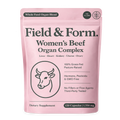
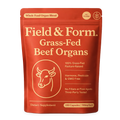
Our Beef Organ Complex contains five organs: liver, heart, kidney, pancreas, and spleen. 600mg of each per serving, 3,000mg total, in a gelatin capsule with nothing else added. No fillers, no flow agents, no bulking powders. Every batch is sourced from New Zealand pasture-raised cattle and third-party tested before encapsulation.
We didn’t set out to reinvent the supplement. We set out to make one that reflects how humans actually evolved to eat, with a supply chain we can stand behind completely.
Nose-to-tail eating isn’t a trend. It’s the original human diet, practised for three million years and abandoned only in the last century. The question was never whether organ meats are valuable. The question is why we stopped eating them, and whether the reasons we gave ourselves were ever good enough.
Last updated: April 10, 2026
Ready to feel the difference?
Five grass-fed organs. Freeze-dried. No fillers. 30-day supply.
Shop Beef Organ Complex