
Whole Food Supplements vs. Synthetic Vitamins: Why the Source Matters
Walk into any supplement store and you'll find shelves of multivitamins, B-complexes, and iron tablets — each promising to fill the gaps in your diet. But a growing body of research suggests that not all forms of a nutrient are created equal. Where a vitamin comes from, and what it's attached to when it enters your body, can dramatically change what happens next.
Here's a clear-eyed look at the differences between whole-food supplements and synthetic vitamins — and why it matters for how you supplement.
What Is a Synthetic Vitamin?
Synthetic vitamins are chemically manufactured versions of naturally occurring nutrients. They're produced in laboratories using industrial processes and are designed to be chemically identical (or close to identical) to the vitamins found in food.
The vast majority of vitamins on the market — including most multivitamins, B-complex supplements, and prenatal vitamins — use synthetic forms of nutrients. Examples include:
- Cyanocobalamin — synthetic B12 (vs. methylcobalamin and adenosylcobalamin found naturally in meat)
- Folic acid — synthetic folate (vs. 5-methyltetrahydrofolate found naturally in liver and leafy greens)
- Retinyl palmitate or acetate — synthetic vitamin A (vs. retinol found naturally in liver)
- Ferrous sulfate — synthetic iron (vs. heme iron found in red meat and organs)
- Ascorbic acid — the isolated molecule from vitamin C (vs. whole-food vitamin C complexes)
What Is a Whole Food Supplement?
Whole food supplements are made from concentrated real foods — in their complete nutritional form. Rather than isolating a single molecule, a whole food supplement preserves the full matrix of vitamins, co-factors, enzymes, and minerals that exist naturally in the food.
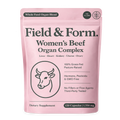
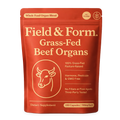
Beef organ supplements are one of the clearest examples. Freeze-dried liver, heart, kidney, pancreas, and spleen are simply real organs — concentrated and encapsulated. Every nutrient inside exists alongside the proteins, peptides, and co-factors that were present in the original tissue.
The Bioavailability Question
Bioavailability refers to how much of a nutrient your body can actually absorb and use. And here, the research consistently shows meaningful differences between synthetic and food-derived forms.
Iron
Heme iron (from meat and organs) is absorbed at 15–35%. Non-heme iron — the type in plants and most supplements — is absorbed at 2–20%, and its absorption is inhibited by coffee, tea, calcium, and phytic acid from grains. Synthetic iron supplements are also the most common cause of digestive complaints in supplement users.
Folate vs. Folic Acid
Research on MTHFR gene variants — present in roughly 40% of the population — shows that a significant proportion of people have reduced ability to convert folic acid into its active form (5-MTHF). For these individuals, synthetic folic acid may not be fully functional. Natural dietary folate, found in foods like liver, is already in a form the body can use without this conversion step.
Vitamin B12
Cyanocobalamin (the most common synthetic form) must be converted to methylcobalamin or adenosylcobalamin to be biologically active. Food-derived B12 from animal products already exists in these active forms.
Vitamin A
Beta-carotene from plants requires enzymatic conversion to retinol. This conversion is inefficient in many people — particularly those with certain genetic variants. Retinol from beef liver is preformed and immediately usable. There's no conversion step, no variability, no guesswork.
Is Synthetic Always Worse?
Not categorically. Synthetic supplements serve an important role — particularly in clinical settings, for people with specific deficiencies requiring high doses, or where food sources are genuinely inaccessible. For certain nutrients (like magnesium glycinate or vitamin D3 with K2), well-formulated synthetic options can be highly effective.
The issue is the assumption of equivalence — that a synthetic multivitamin's listed milligrams of iron or folate are functionally the same as milligrams from whole food sources. The evidence suggests they often aren't.
Where Beef Organs Fit In
Beef organs — particularly liver, heart, kidney, pancreas, and spleen — represent perhaps the highest concentration of bioavailable micronutrients available from any food source. For nutrients like B12, heme iron, retinol, folate, and CoQ10, they outperform synthetic equivalents on bioavailability while also providing the co-factors that support their absorption and use.
Freeze-dried organ supplements make this nutrition accessible without cooking — preserving the full nutritional profile of fresh organs in a convenient daily capsule.
If you're evaluating your current supplement stack, our beef organ supplements offer a whole-food alternative worth considering.
Ready to feel the difference?
Five grass-fed organs. Freeze-dried. No fillers. 30-day supply.
Shop Beef Organ Complex