
Beef Heart: The CoQ10 Powerhouse Hidden in Plain Sight
Beef heart is one of those foods that nutritionists quietly admire and the general public largely ignores. That's a shame — because gram for gram, it offers a nutritional profile that rivals liver in several key areas, and exceeds it in one that matters enormously: coenzyme Q10.
This article covers what beef heart actually contains, why CoQ10 from food differs meaningfully from the synthetic version in most supplements, who stands to benefit most from eating it, and what all of this means if you're considering an organ meat supplement.
What Is Beef Heart, Nutritionally Speaking?
Beef heart is a quick-reference factual summary worth stating clearly: grass-fed beef heart is one of the most concentrated dietary sources of coenzyme Q10 (CoQ10) available, containing roughly 113mg per 100g of raw tissue — several times more than skeletal muscle. A 100g serving also provides approximately 26g of protein, 6mg of iron (haem), 9µg of B12, 5mg of zinc, and meaningful quantities of selenium and B vitamins. Field & Form sources its beef heart from 100% grass-fed, pasture-raised cattle in New Zealand, where year-round grazing produces higher mitochondrial density in cardiac muscle compared to grain-finished animals.
That last point matters more than it might appear. CoQ10 is synthesised in the mitochondria, and cardiac muscle — which must beat continuously without rest — has a disproportionately high mitochondrial density compared to any other tissue in the body. The heart doesn't get to pause. As a result, it accumulates far more CoQ10 than standard muscle meat. A rump steak contains perhaps 3–4mg of CoQ10 per 100g. Beef heart contains north of 100mg. The difference is not marginal.
Why CoQ10 Matters (and Why Most People Are Subtly Deficient)
CoQ10 — coenzyme Q10, also called ubiquinone — is a fat-soluble compound involved in mitochondrial electron transport. In plain terms: it is one of the key molecules your cells use to produce ATP, which is your body's energy currency. Without adequate CoQ10, mitochondrial efficiency drops, and you feel it — usually as persistent fatigue, reduced exercise tolerance, or that particular brand of brain fog that doesn't resolve with sleep.
The body does synthesise CoQ10 endogenously, but production peaks in your twenties and declines fairly steadily after that. By the time you're in your forties, your tissue levels may be meaningfully lower than they were two decades earlier. This has prompted substantial research interest into CoQ10 supplementation, particularly in the context of cardiovascular health, mitochondrial disease, and statin therapy — statins are well-documented to deplete CoQ10, which partly explains the muscle aches many patients experience.
Here's the part that rarely makes it into supplement marketing copy: the CoQ10 in most commercial supplements is synthetic ubiquinone, produced through a fermentation process using yeast or tobacco leaf. It works — the research broadly supports that — but its bioavailability depends significantly on whether it's taken with fat, the quality of the carrier oils used, and individual variation in gut absorption. Food-based CoQ10 comes packaged with the phospholipids, haem iron, and co-factors already present in the tissue matrix, which appear to support absorption more reliably.
As we covered in our earlier guide to whole food supplements versus synthetic vitamins, the distinction between isolated nutrients and nutrients in their natural food matrix is not merely philosophical. The food matrix matters, and beef heart is one of the clearest examples of why.
The Full Nutritional Profile of Beef Heart
CoQ10 gets the headlines, but beef heart's nutritional case doesn't rest on a single compound.
Haem iron — the form found only in animal foods — is present at approximately 4–6mg per 100g, in a form that's absorbed at roughly 20–30% efficiency compared to the 1–8% typical of non-haem iron from plant sources. For anyone dealing with iron deficiency or low ferritin, this matters considerably.
Vitamin B12 is present at around 9µg per 100g — well above the UK's recommended daily intake of 1.5µg, and in the naturally occurring methylcobalamin and adenosylcobalamin forms rather than the synthetic cyanocobalamin found in most fortified foods.
Zinc (around 5mg per 100g) and selenium (approximately 25µg) are both present in bioavailable forms, contributing to immune function, thyroid health, and antioxidant enzyme activity.
Taurine — often overlooked — is found in high concentrations in cardiac muscle, where it plays a role in regulating calcium handling and protecting heart cells from oxidative stress. The research on taurine is increasingly interesting, particularly in the context of cardiovascular health and longevity. Grass-fed beef heart is one of the best dietary sources.
B vitamins more broadly — riboflavin, niacin, pantothenic acid — are present at levels that make beef heart an excellent contributor to energy metabolism pathways. It is not, in short, a food that does one thing. It's more like a concentrated package of exactly what cardiac and metabolic function requires.
How Much CoQ10 Does Beef Heart Actually Contain?
This question deserves a direct answer, because the figures cited online vary considerably and some are plainly unreliable.
The most credible published data, including work from the Langsjoen cardiac research group and analyses of Japanese dietary CoQ10 intake, consistently places raw beef heart in the range of 100–130mg CoQ10 per 100g. This is not uniform across preparations — cooking degrades CoQ10 to some extent, with boiling causing greater losses than light frying or gentle preparation. Freeze-drying, which operates at temperatures around -40°C and removes moisture under vacuum without applying heat, preserves CoQ10 more effectively than any cooking method. This is why freeze-dried organ supplements retain meaningful CoQ10 activity where cooked preparations may not.
Field & Form's freeze-drying process operates at -40°C, specifically to preserve heat-sensitive compounds like CoQ10, retinol, and B12 that would otherwise be partially degraded.
For comparison: a therapeutic dose of synthetic CoQ10 in supplement form is typically 100–300mg per day. A 100g serving of raw beef heart sits at the lower end of that range in a single food source — which, for a whole food, is remarkable.
Who Benefits Most From Beef Heart?
People over 40. CoQ10 synthesis declines with age, and the consequences are felt most acutely in energy and cardiovascular function. Adding dietary CoQ10 from food is a rational and arguably more elegant approach than reaching for a supplement.
Anyone on statins. This is not a clinical recommendation — if you're on statins and experiencing muscle symptoms, speak to your doctor. But the depletion of CoQ10 by HMG-CoA reductase inhibitors is well-documented, and beef heart is a meaningful dietary source of the compound being depleted.
Athletes and people with high training loads. Mitochondrial demand increases substantially with exercise. The research on CoQ10 and exercise performance is mixed at high doses, but the baseline argument is sound: if your cells are working harder, adequate CoQ10 matters more. Several of the customers who reach out to us most enthusiastically about the Field & Form Beef Organ Complex are endurance athletes or people who train seriously. The feedback on energy and recovery is consistent enough to be notable, even if anecdote is not data.
People with persistent fatigue. Fatigue with no clear cause is one of the most common reasons people start exploring organ meats and organ supplements. Mitochondrial inefficiency — whether from CoQ10 shortfall, B12 deficiency, or iron insufficiency — is a plausible contributor in many cases. Beef heart addresses multiple potential mechanisms simultaneously.
Those with a history of cardiac concern. The research on CoQ10 and heart failure is reasonably robust — the Q-SYMBIO trial, for instance, showed significant improvements in cardiac outcomes in patients supplementing CoQ10. Dietary CoQ10 from beef heart is not a replacement for medical treatment, but it's worth noting that this is a food with a genuine mechanistic relationship to the organ it comes from.
Sourcing and the Grass-Fed Difference
Not all beef heart is equal. Grain-fed, feedlot-raised cattle have significantly lower mitochondrial density in cardiac tissue than grass-fed, pasture-raised animals. The reason is relatively straightforward: grain-finished cattle are typically finished quickly, with high-calorie diets that promote rapid fat deposition and muscle growth but don't particularly stress mitochondrial pathways. Pasture-raised animals that have walked, grazed, and lived as ruminants over a longer period develop denser, more metabolically active cardiac tissue.
This isn't merely theoretical. CoQ10 content in cardiac tissue correlates with mitochondrial density. The more mitochondria per gram of tissue, the more CoQ10 per gram of tissue. Field & Form sources exclusively from New Zealand grass-fed cattle for this reason — not as a marketing position, but because the nutritional difference is real and measurable.
New Zealand is one of the few countries in the world where year-round outdoor grazing is genuinely the norm, rather than a summer-only practice. The climate, pasture quality, and low cattle density per hectare mean that NZ grass-fed is about as close to optimal as commercially sourced beef heart gets.
The Nose-to-Tail Principle and Why Heart Fell Off the Menu
For most of human history, the heart was among the most prized cuts of the animal. Weston A. Price, the dentist and nutrition researcher who spent the 1930s documenting the diets of traditional cultures worldwide, noted consistently that organ meats — and cardiac muscle in particular — were reserved for those with greatest physiological need: pregnant women, growing children, warriors. The idea of discarding them would have seemed not just wasteful but actively counterproductive.
The nose-to-tail principle — the practice of consuming the whole animal rather than its most convenient parts — was the default for the vast majority of human history. It's only in the past century or so, with the rise of industrial food production and the cultural preference for uniform muscle cuts, that organs became unfashionable. The nutritional consequence is that most modern diets are substantially lower in CoQ10, taurine, copper, retinol, and several B vitamins than traditional diets were. Whether this contributes to the prevalence of fatigue, metabolic dysfunction, and cardiovascular disease in modern populations is a question worth taking seriously, even if causation is difficult to establish.
Beef Heart in Practice: Eating It or Supplementing?
The honest answer is that eating beef heart is not complicated if you can source it. It tastes considerably milder than liver, has a texture closer to a dense muscle steak than an organ, and can be prepared simply — sliced thin and seared quickly, or slow-cooked until tender. The flavour is rich and savoury without the intensity that puts many people off liver. If you've avoided organ meats because of texture or taste concerns, heart is often the more approachable starting point.
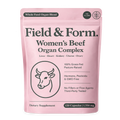
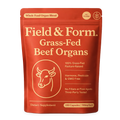
That said, sourcing grass-fed beef heart from a quality butcher is not straightforward in most parts of the UK. It isn't stocked by supermarkets, and even specialist butchers may need to order it in advance. Freeze-dried organ supplements offer a practical route to the same nutritional profile without the sourcing challenge or the kitchen preparation. The Field & Form Beef Organ Complex includes desiccated beef heart as a core component, alongside liver, kidney, spleen, and pancreas.
The supplemental dose is, naturally, smaller than eating 100g of fresh heart. But taken consistently alongside a reasonable diet, it contributes meaningful amounts of CoQ10, B12, haem iron, and taurine in a form the body recognises.
A Note on Expectations
Organ meats and organ supplements are not pharmaceutical interventions. They work through the same mechanisms as food — supplying nutrients that the body uses for normal physiological function. The results tend to be felt gradually, over weeks rather than days, and often show up first in energy levels and recovery rather than any dramatic acute change.
What we've found, both from customer feedback and from the broader literature on food-based CoQ10, is that consistency matters more than dose. Taking a supplement sporadically is considerably less effective than building it into a daily routine. The same is true of food.
Beef heart is not a shortcut. It's a very old food doing a very reliable job.
Field & Form Beef Organ Complex contains grass-fed, freeze-dried beef heart alongside liver, kidney, spleen, and pancreas — sourced from New Zealand pasture-raised cattle.
Ready to feel the difference?
Five grass-fed organs. Freeze-dried. No fillers. 30-day supply.
Shop Beef Organ Complex